We can have a clear, well-articulated model of historical thinking. We can name the moves: sourcing, contextualization, corroboration, inference. We can even break down each guidepost move into precise, components. But none of that matters if the task we design does not actually elicit those moves from students.
This is the central challenge of observation: how do we design a task that makes invisible thinking visible?
Observation should begin with the specific cognitive moves we want to see. If our model tells us that sourcing includes identifying author, purpose, and audience, then the task must require students to do those things in a visible way.
Below is a series of questions a teacher might use to elicit historical thinking in relation to the provided source.
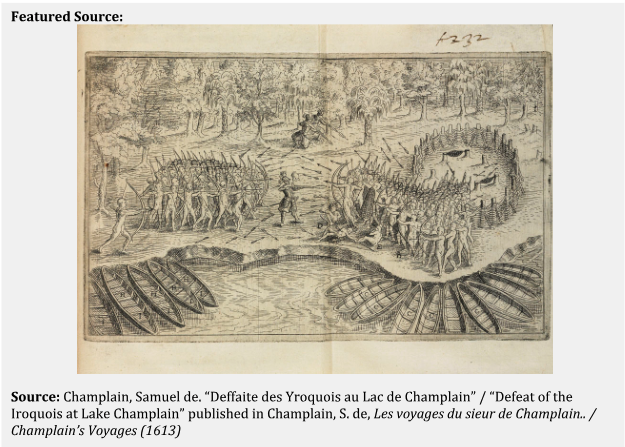
- Question A: Analyze the Source.
- Question B: Why might this source be useful as evidence of what happened during the battle at Ticonderoga/Lake Champlain? What about this source might make it less useful as evidence of what happened during the battle at Ticonderoga/Lake Champlain?
- Question C: “How does the author’s position and the time in which the source was created affect its reliability?
- Question D: To what extent is this source useful in understanding what happened during the battle of Ticonderoga. Your answer must compare the sources using at least two of the following:
- Author/creator
- Time of creation
- Purpose/audience
- To what extent can the painting “Jacques Cartier Meeting the Indians at Stadacona, 1535” be used as evidence of what actually happened during the meeting?
- In your response, you must:
- Identify when the painting was created relative to the event
- Explain the purpose of historical paintings like this
- Explain what the painting can show historians
- Explain what it cannot reliably show
- In your response, you must:
Which question do we ask? My honest answer is, it depends.
Broadly speaking, I’d suggest that constraints help reveal thinking. Particularly for novice historians. The best tasks must require students to attend to author, time, and purpose—not simply allow for it. This often means embedding those elements directly into the structure of the question or response space. Rather than asking, “Is this source reliable?”, we might ask, “How does the author’s position and the time in which the source was created affect its reliability?”
The difference is subtle, but significant. In the latter, the thinking is specified—and therefore more likely to be visible in student responses. Constraints such as requiring students to justify a claim using specific sourcing factors make particular forms of thinking more probable and can help us pinpoint exactly where student reasoning breaks down.
But they also introduce a new problem: over-scaffolding the thinking itself.
While a constraining question may be helpful at younger grades, at a certain point, we will want to determine whether sourcing has become a habit of mind, that students are attending to the necessary metadata independently rather than simply following instructions.
The goal is not just that students can perform sourcing when prompted, but that they begin to internalize these moves—to notice author, context, and purpose without being told.
For this reason, most tasks on To The Past aim for a middle ground, often leaning slightly toward less structure. Questions such as “What are the strengths and limitations of this source as evidence for this inquiry?” are intentionally open enough to require students to select and apply relevant sourcing moves on their own. And, depending on their student performance and assessment data, to allow teachers to provide more flexible and responsive scaffolding as needed. Some students may need explicit prompts which can be provided orally or written on a classroom whiteboard (“Consider the author, time, and purpose…”), while others may be ready for more open ended tasks.
Through careful guidance and prompting from experienced teachers, all students can move towards these more complex open-ended prompts without need for explicit prompting.
Designing for observation is ultimately about discipline. It requires us to stay tightly aligned to our model of cognition, to be intentional about how tasks elicit specific thinking moves, and to use structure and constraint in ways that make student thinking visible.
When this is done well—and it is difficult—the need to “read between the lines” is reduced. Instead, we are able to read student thinking more directly in their responses, because those responses have been deliberately shaped to reveal it.
That clarity is what makes meaningful feedback possible.