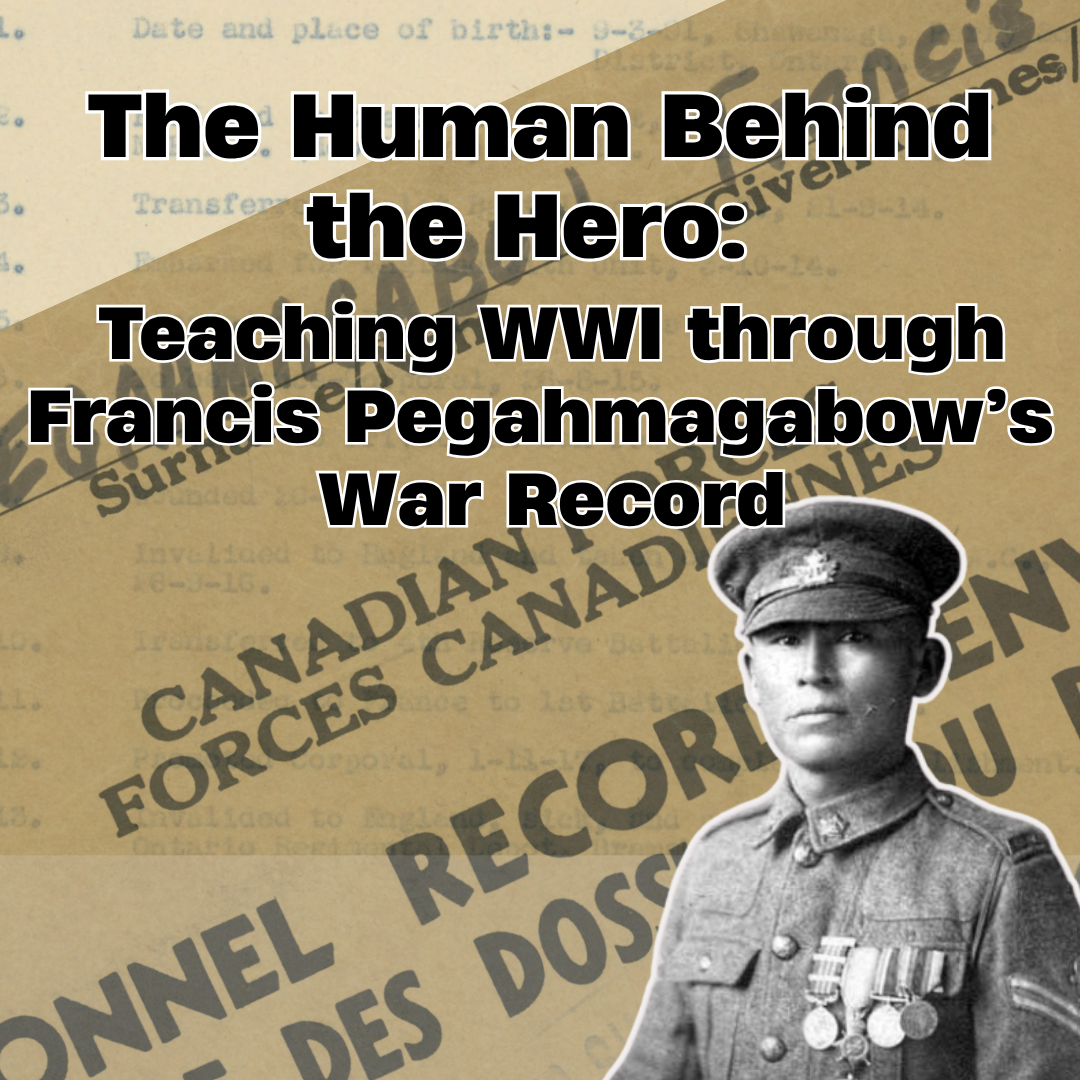
The war record of First World War soldiers can provide unique insight into the experiences of soldiers. I’ve previously written about how I use the war records in my Grade 10 History class to highlight the conditions faced by Black soldiers. The same can be true of Indigenous soldiers. In particular Francis Pegahmabow’s showcases his experiences with, what we can assume, are the symptoms of shellshock, as well as some of the challenges he faced as an Indigenous soldier.
War records are also a great way for students to question what is present on the page and it can humanize the experiences of the soldier. This is especially true for Indigenous soldiers, like Pegahamabow, whose experience in the war may not be as fully realized in many secondary sources. For example:
Page 10: Pegahmagow asks a supervisor of Casualty Welfare to assist him in obtaining his Service button. Why was he denied it in the first place or why was there a delay in receiving it?
Page 16: The details about receiving his Military Medal are listed, but the page has been partially destroyed. What remains gives some insight into why he received it but the full scope of it remains unclear. Why was the page damaged?
Page 19: There is a reported incident over a towel in the lavatory with another soldier that caused Pegahamagabow to slap the other man. The author notes that Pegahmagabow has been experiencing “distorted ideas” and “delusions.” Whose perspective should we, as historians, believe? Why must historians be careful when using a medical report that judges the mental state of an Indigenous soldier? “
Page 22: There is an interesting account from Pegahmagabow about how he was “buried three times” and “blown up once.” The author notes that he also had “trouble” with other men when getting dressed in the morning. Not only does this page showcase some of the physical experiences of First World War soldiers, but there is a pattern of targeted behaviour that Pegahmagbow is facing, which could contribute to his mental consequences. Students might want to look at the ways in which Pegahmagabow had to fight in the First World War on both a physical and social front.
Page 33: This section offers an interesting overview of what Pegahmagabow was experiencing behind the front lines. He feels his fellow soldiers see him as a spy, that he has the desire to kill another officer, feels that his commanding officer is persecuting him and that he heard voices. The author does acknowledge that Pegahmagabow denies there’s anything wrong with him, but is insistent that others think he’s a spy. While his overall health is reported as good with rapid and rational responses, Pegahamagabow apparently becomes “depressed” over small things and that he’s been a “man apart from the others.” How might a soldier feeling isolated impact their psychological breakdown?
The above is just a sampling of the treasure trove that Pegahamagabow’s war record offers. It’s truly an interesting look into how he navigated the First World War and the apparent burgeoning symptoms of shell shock. While not all war records have such depth of content, I always find it worthwhile when a name of a soldier crosses my desk, to see what potential avenue of discovery theirs holds.
Other Indigenous soldiers’ war records worth checking out: