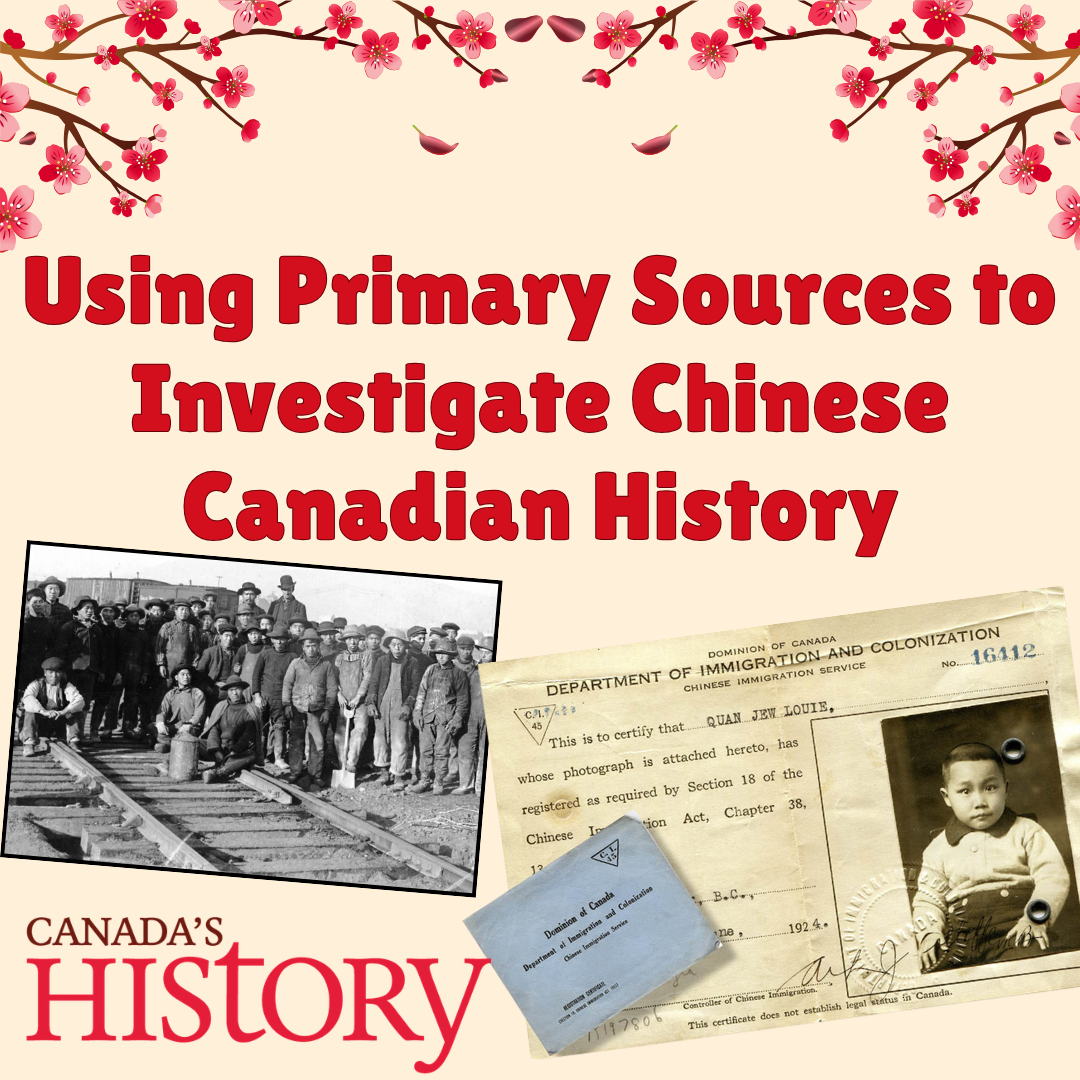
Canada’s History is a treasure trove of primary source materials. From their magazine archives to what can be found in their regular mail outs. This past month, in acknowledgement of Asian Heritage Month, they included links to a lesson plan “Resilience of Chinese Immigrants and their Descendants.” While the lesson plan (French version) itself proved a good starting point, it made me think of OHASSTA president, Sarah Murdoch’s recent article for the Rapport, “Decoding the Past: Using WWII Battle Photos and Multiple Sources” wherein she provided strategies for students to make sense of photographs. While her article specifically zeroed in on World War 2 photos, the strategy could absolutely be applied to the primary sources curated by Canada’s History.
The resource includes 30 primary source documents that span a wide timeframe. I would suggest teachers instead curate their selection to their unit of interest. For CHC2D/P, there are a number of images that would act as a good minds-on activity to a lesson on the enacting of the 1923 Chinese Exclusion Act. I particularly felt that the primary sources 1, 4, 5, 6, 11, 12, 14, 15, 17c, 18, 19, and 30 would be a good starting point for a gallery walk or group discussions following the parameters set out in Sarah’s article.
Some of the images include harmful language, so teachers should take caution and ensure that students are aware that many of these terms are considered offensive today. Reviewing with them historical context and historical perspective and the use of the terms during the time period would help students critically examine the past while understanding why such language is harmful and unacceptable today.
By carefully selecting and framing these sources, teachers can move students beyond simply “looking” at historical photographs or documents toward actively interrogating them. Students can ask who created the source, what message it was trying to communicate, whose perspectives are represented or omitted and how the source reflects broader attitudes and policies of the time. These kinds of discussions not only deepen historical thinking, but also help students recognize the ways discrimination and exclusion were normalized within Canadian society and law.
Teachers may also wish to pair these sources with contemporary reflections from Chinese Canadians to help students draw connections between past injustices and ongoing conversations about identity, belonging, and inclusion in Canada today.


