
By Orit Yakuel, Founder, Teach Jewish History
Open one of the world history textbooks used in many classrooms and look for the Jewish people. You’ll most likely find them early, in the ancient Near East, beside Egypt, Mesopotamia, and Persia. They often get about a page, sometimes a few, covering monotheism, the patriarchs, the Exodus, the kingdoms of David and Solomon, and the Babylonian exile. Students go on to follow India and China, Christianity and Islam, across the centuries. The Jewish story stops after the ancient world, even though the Jewish people, their faith, and the texts they still read in Hebrew continued from that world to today. A 2009 study of two major publishers’ world history textbooks found that, of the three monotheistic religions, Judaism received the least coverage. Turn the pages, past Rome, the medieval world, Spain in 1492, the Enlightenment, and the Jewish people reappear two thousand years later, as victims of the Holocaust. Missing too is the long story of how the hatred that led there was built, idea by idea and law by law, across centuries and continents.
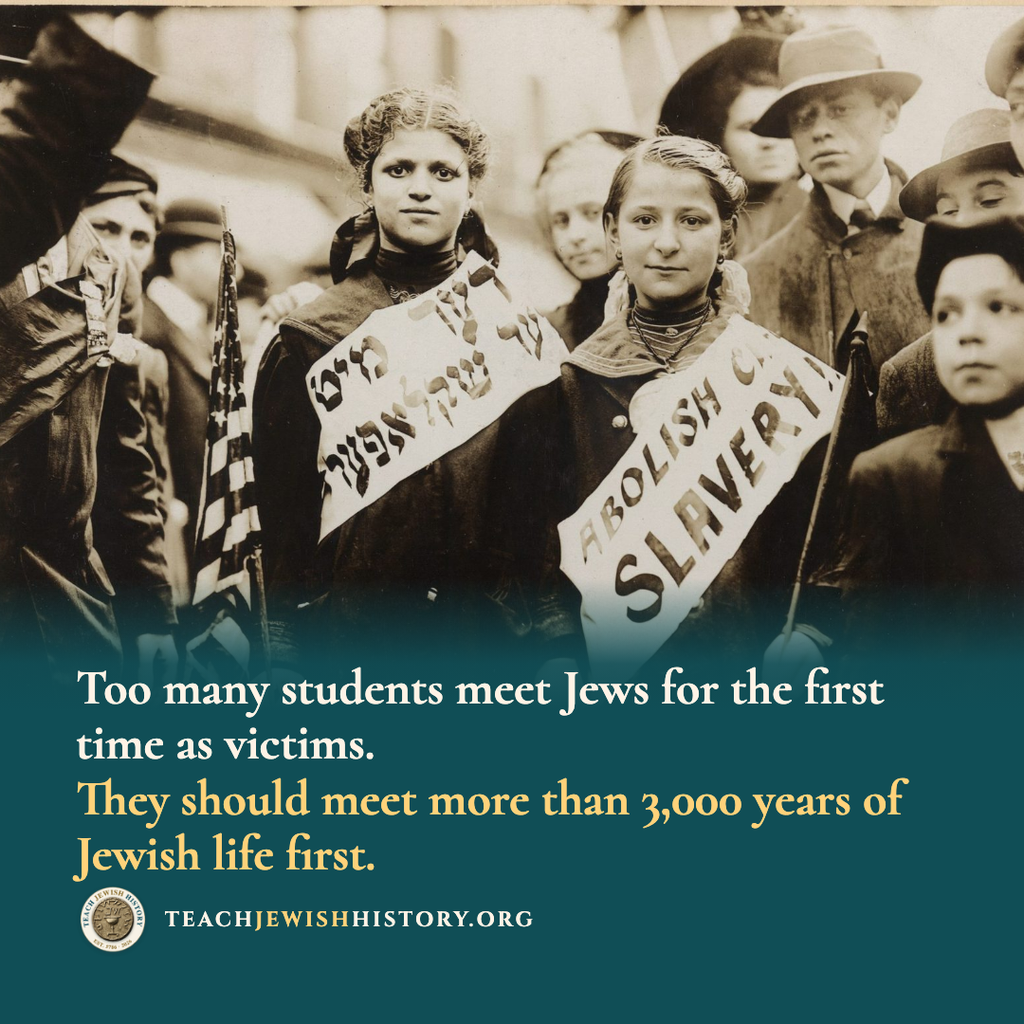
That is the gap I kept running into. Too many students meet Jews for the first time as victims. They should meet more than 3,000 years of Jewish life first.
Where things stand
Holocaust education has grown, and that matters. In Ontario, learning about the Holocaust has been required in Grade 6 since 2023, and since this school year, the revised Grade 10 history course includes the Holocaust and antisemitism in Canada. In the United States, a 2026 federal review found that 42 of the 50 states and D.C. require Holocaust education through academic standards or state law. In England, the Holocaust has been a compulsory part of Key Stage 3 history since 1991.
What it often lacks is the history around it, both the Jewish life that flourished for centuries across Europe, the Middle East, and North Africa, and the long history of antisemitism that made the Holocaust possible. A student can reach the Holocaust having met the civilization that was destroyed only in passing, with little sense of how the hatred behind it took shape. The Holocaust can then feel like a sudden break, when it drew on ideas, laws, and events that reached back centuries. And the story doesn’t end in 1945. It continues through the trials and reckoning after the war, the founding of the State of Israel, the departure of the Jewish communities of the Arab world and Iran, Jewish life today, and the forms antisemitism takes now.
What the site offers
Teach Jewish History (teachjewishhistory.org) offers free teaching materials in Jewish history and the history of antisemitism, from the ancient world to today, for K–12 and college classrooms. It tells the whole arc, with Jewish life and the history of antisemitism side by side. It follows Jewish communities from Baghdad to Venice to New York, and traces antisemitism from its ancient roots through medieval Christian Europe and the Islamic world to the racial theories of the modern era and the present.
The site works two ways. Read in order, its chapters form an introductory textbook, organized in six units: The Jewish World, Communities Across the World, The Evolution of Antisemitism, The Holocaust Era, Jewish Contributions, and Memory, Responsibility, and Today. Taken one at a time, each chapter works as a single lesson that drops into the history, social studies, and English classes you already teach. No new course is needed.
Every chapter is built on primary sources, the original documents and records of the time, and ends with a full source list. Each one includes discussion questions and a printable PDF. On contested questions, the chapters quote the record and attribute claims, and several close with what historians still debate.
Around the chapters, you’ll find teaching guides, lessons for kindergarten through Grade 5, a timeline, a glossary, and a museum of objects with the holding institution named. There is also a chart of the recurring cycle of antisemitism, a sourced guide to hate symbols, and a record of landmark court rulings. There are no logins and no ads, and it’s for public and private schools alike.
Made for the curriculum you already teach
For Ontario teachers, there is an Ontario edition of the site’s Standards Companion. It matches the chapters to Ontario’s curriculum, from Grade 6 social studies through Grade 12 world history, course by course, so you can see exactly where each chapter fits. There are also editions for other provinces, such as Alberta and British Columbia, for every U.S. state, and for countries such as the UK, Australia, and South Africa.
The Ontario edition is at teachjewishhistory.org/tjh-teacher-guide-on.pdf
How to use it
Start with the course you’re teaching. The Ontario edition places each chapter course by course, and taken in the order of history, it looks like this.
For the ancient world, in Grade 11 world history (CHW3M), begin with Who Are the Jews? and The Land of Israel, from the first unit, The Jewish World, much of which also suits middle school.
For the medieval world, Grade 11 and 12 world history (CHW3M and CHY4U) take up the expulsions of Jewish communities from European states. The Expulsions, The Blood Libel, and The Ghetto System show how the hatred took hold, and Rashi and Maimonides show the Jewish learning that flourished alongside it.
For the nineteenth and twentieth centuries, in Grade 12 world history (CHY4U), The Racial Turn, The Russian Pogroms, The Protocols Forgery, and The Nazi Synthesis trace how modern antisemitism took shape, alongside Theodor Herzl and The Modern State of Israel.
For the Holocaust, in Grade 6 social studies and Grade 10 history, start with The Years Before the Killing and Jewish Resistance and Rescue, and add The Holocaust in the Middle East and North Africa.
For the years after 1945, Grade 10 history also covers the Holocaust’s impact on Canada and on human rights. Liberation and the Displaced Persons, The Postwar Trials, and Contemporary Antisemitism carry the story to today.
For the elementary grades, the K–5 lessons introduce Jewish life the way the early grades already introduce other peoples and cultures, through communities around the world, stories, foods, music, and words. The hard history is held for later grades.
The For Teachers page gathers the teaching guides, lessons, and Standards Companions in one place, at teachjewishhistory.org/for-teachers. The Table of Contents shows the whole site at a glance, at teachjewishhistory.org/table-of-contents.
Who it’s for
Classroom teachers from kindergarten through college, their students, and curious readers of any age. The chapters are written for students meeting this history for the first time, with no background assumed.
Pass it on
If a chapter works in your classroom, send it to a colleague. The For Teachers page has a ready email to share the site with your department or district. If your school, board, or association keeps a list of teaching resources, or you know an organization that does, I’d be glad to see Teach Jewish History on it. And you can follow along on Instagram at @teachjewishhistory, where each post opens a piece of the history.
This history is well documented. It lives in archives, museums, and generations of scholarship. What students have been missing is the chance to see it whole. Teach Jewish History brings it together, chapter by chapter, so students can meet the people in every place they lived, and understand the ideas, laws, and events that made the catastrophe possible, before they reach the catastrophe itself.
Orit Yakuel is the founder of Teach Jewish History (teachjewishhistory.org), free teaching materials in Jewish history and the history of antisemitism, K–12 and college.