If cognition defines what we want students to think, and observation determines how we make that thinking visible, then interpretation is where we answer the most important question:
What does this student work actually reveal about their thinking?
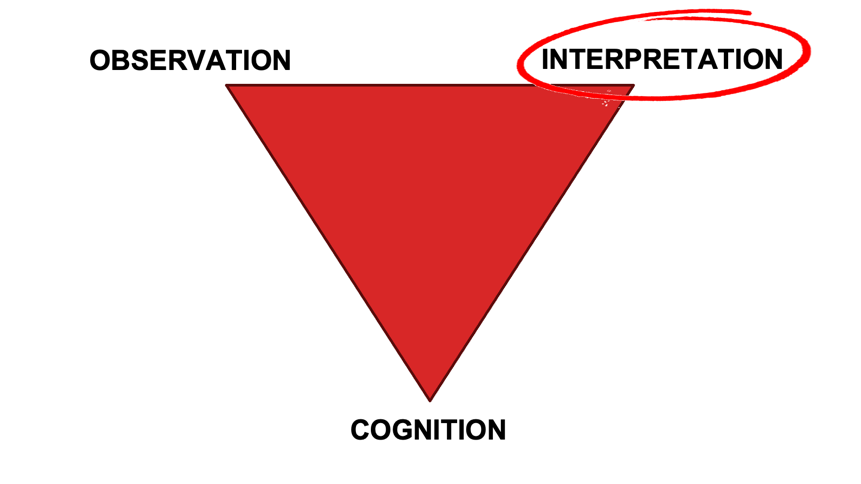
This is the third corner of the assessment triangle—and, in many ways, the most complex. Our best-laid plans, or in this case, assessments, often go awry because, well, we are dealing with humans. Making sense of student responses—which can sometimes travel down unexpected interpretative paths—can still be disorienting.
When a student evaluates a House of Commons speech given by John A. Macdonald in 1866 and concludes, “This source is biased because Macdonald supported Confederation,” how should we interpret that?
- Do they understand how perspective shapes evidence?
- Are they using “bias” as a vague label?
- Are they connecting author → perspective → limitation?
A more sophisticated student might write: “This speech reflects Macdonald’s support for Confederation, as he is clearly emphasizing benefits and downplaying risks to persuade those on the fence in Parliament.”
Here, the analysis is clearer. Vague notions of bias are replaced with a more precise explanation of how authorship and context shape what is included and omitted. This is the thinking we are interested in.
While the example above is relatively straightforward, other factors—such as literacy demands—can sometimes obscure students’ historical thinking. A student may have a strong grasp of sourcing but struggle to express it clearly, while another may write in polished, academic language that sounds convincing without demonstrating genuine understanding. Without a clear model of what proficient sourcing looks like, these responses can easily be misinterpreted.
Consider the responses below:
• Student A: Strong Thinking, Weak Expression
“Macdonald is for Confederation so in this speech he mostly talks about the good things and not really the bad stuff because he wants other government people to agree with him and vote for him so he can continue to do the things he wants as Prime Minister.”
Although the student’s phrasing is awkward and informal (“good things,” “bad stuff,” “government people”), they identify Macdonald’s position on Confederation, explain how that position shapes the content of the speech, and recognize the purpose of the speech—to persuade members of Parliament to support Confederation. Despite the weak writing, the historical thinking is strong.
• Student B: Weak Thinking, Strong Expression
“This speech reveals Macdonald’s clear bias. His perspective influences what he includes and how it is stated, which is shaped by his audience and may limit the source’s reliability.”
This response contains much of the academic language teachers often look for (“perspective,” “audience,” “reliability”) and is written in fluent, controlled prose. However, it never explains how Macdonald’s perspective shapes the content of the speech. There is no reference to Confederation, Parliament, or the persuasive purpose of the address. Instead, “bias” functions as a label rather than an explanation. In fact, this response could be used as a generic template for almost any historical source.
This is where our earlier work—breaking down sourcing into specific cognitive moves—becomes essential. Interpretation depends on having clear criteria for what counts as evidence of thinking. Instead of asking, “Is this a good answer?” we ask:
- Did the student identify relevant sourcing information?
- Did they connect that information to perspective or reliability?
- Did they use that connection to qualify the usefulness of the source?
In other words, we interpret student work by mapping it back onto the cognitive moves we value.
One of the most powerful outcomes of this approach is that it allows us to see partial understanding with precision. And then interpreting student work becomes less of an endpoint, and more like a bridge to instruction. Once we can see student thinking clearly, we can:
- Provide specific feedback
- Adjust instruction
- Design next steps that target actual needs
I set out to design assessment tools for Canadian History teachers. But over time, I’ve come to see them differently. These are not just assessment tools—they are teaching tools. Yes, they can be used for evaluation. But the real value lies in the conversations they generate and the feedback they make possible. Those moments—when thinking becomes visible and can be responded to—are where the most meaningful learning happens.