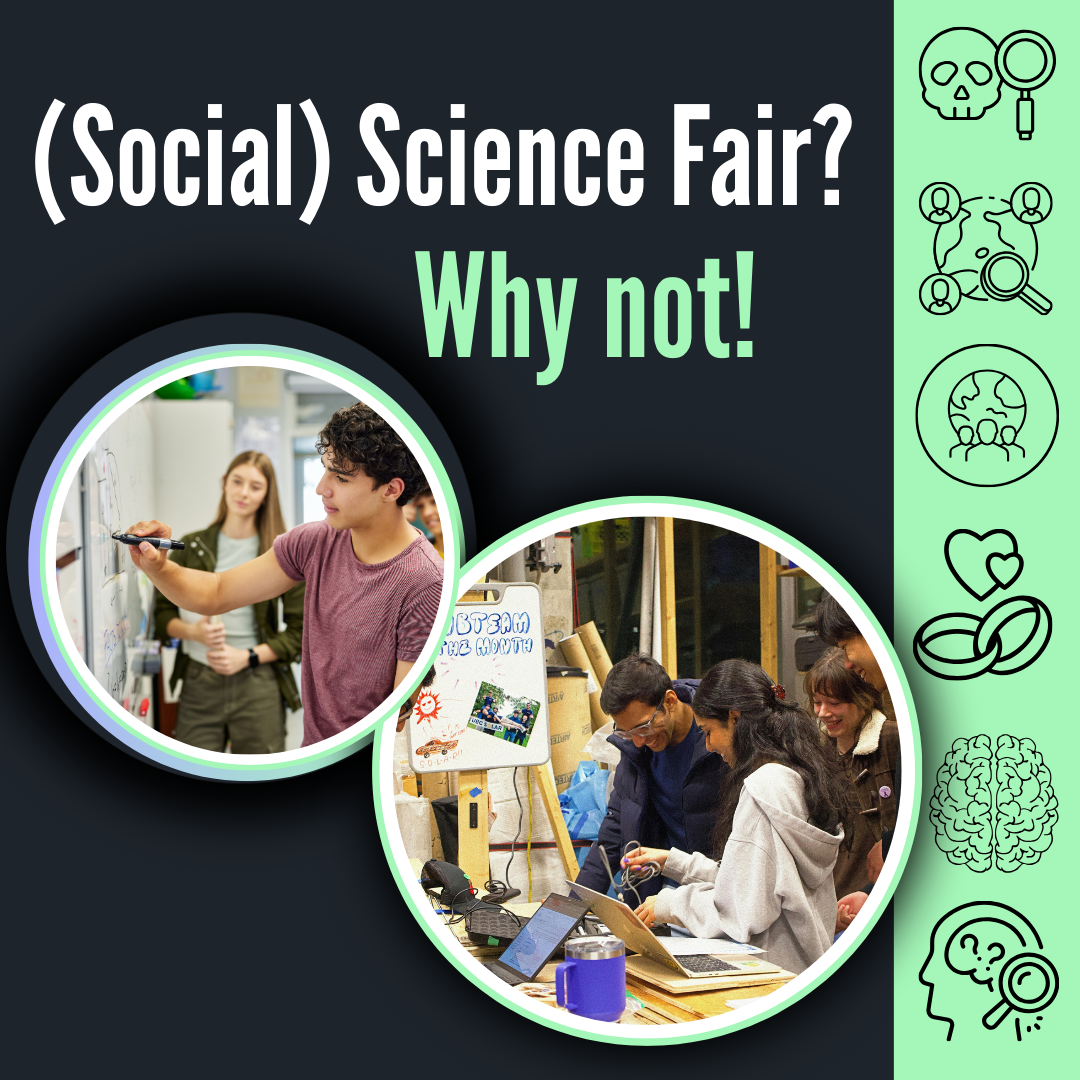
Science fairs have always been a quintessential part of any child’s science programming. I remember sitting in my basement with my dad helping (doing?) a lot to ensure that my 6th grade poster board was something that would stand out in our class’s science fair. Recently I’ve watched from a distance as my colleagues in Chemistry created an in-house science fair, with the top 5 projects moving on to the York Region Science & Technology Fair at York University. It had me thinking: could I do this in my social science classroom?
I won’t lie, I was nervous and it was risky. But in reviewing the parameters of the science fair, I realized that it overlapped nicely with the expectations I’d already put in place for my HSP3U students’ cumulative performance task (CPT). My project just needed some slight tweaking to bring it in line with the expectations for the science fair, which were probably more in line with what post secondary social science programs would expect in their project developments anyway.
While the Science & Technology Fair focuses on the physical and life sciences, there was an overlap in the categories of digital technologies and disease & illness. I decided to plug some of the sample topics given by the fair alongside the HSP3U curriculum into generative AI to populate a list of potential topics. I was pleasantly surprised by how many options there were for students to develop their own direction in topic selection, as well as the potential with the fair’s discovery and innovation challenges. I also made the decision to structure the project as a Design Thinking Project as that was ultimately what it was at its core.
In my department, students’ CPTs are worth 10% so I needed to ensure that I wasn’t devaluing the crux of the assignment- the final paper and the poster board- but I also needed those early brainstorming and research gathering opportunities to count. As a result, I pulled the early parts out of the CPT bin and made them part of their term work.
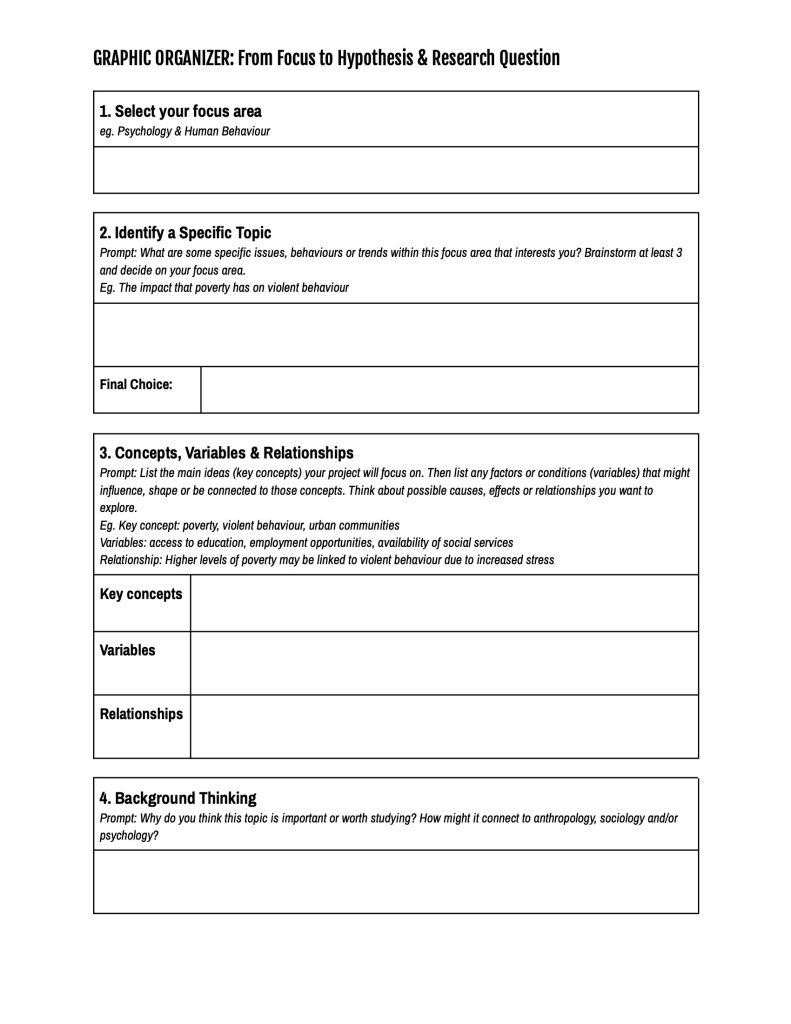
In this phase, the students narrow their topic focus and develop their research question and hypothesis. In terms of topics, there was a broad exploration among the students. Social media was a popular choice, but beyond that there was diversity. Students were able to go in whatever direction appealed to them from the impacts of divorce on families, to soccer fandom, to the impacts of mental health on behaviour. I even had a student who wanted to explore the effectiveness of speed cameras. One challenge that did come up was that students were already thinking about what they wanted to center their final product on: discovery or innovation. I had to repeatedly remind them that they were just in the early stages of exploring their topic, developing their research question and hypothesis.
Once they’d chosen their focus, the students completed a graphic organizer which helped lead them toward the development of their research question and hypothesis. At this stage, after submission and assessment, I allowed students the opportunity to repair and resubmit any ineffective structuring for re-evaluation. It is my belief that with a well crafted research question and hypothesis, it allows the students to reflect on why something didn’t work and gives them an opportunity to demonstrate improved thinking and reflection.
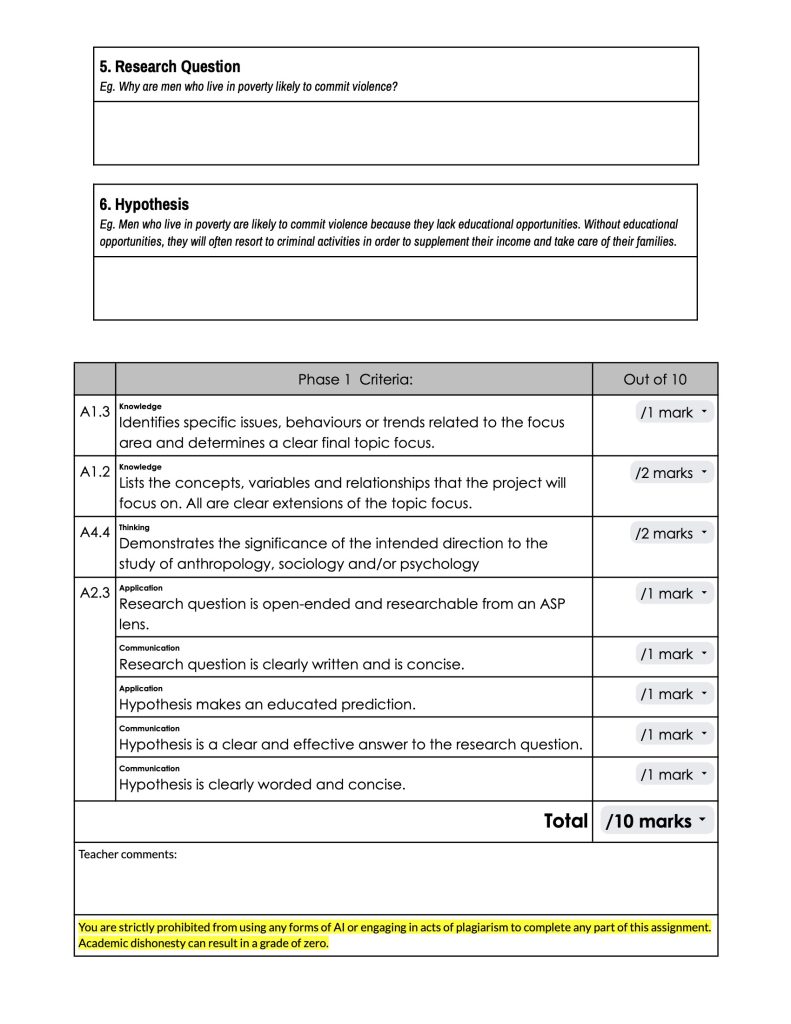
If a student attempted to use AI to construct this part, rather than relying on their own thinking and processes, I found that the responses were subpar and not at all effective to the task at hand.
The evaluation of this portion went into the term work.
Resources:
Phase 2: Consolidating Research
The purpose of phase 2 is ultimately to keep students engaged in the process and encourage them to be continually researching and thinking about their topic. It is in this phase where I introduce the students to the end goal of the project and the project types.
There are two project types in the Science & Technology Fair: discovery and innovation. Innovation proved to be less popular among my students, but for those that did it, some came up with some interesting concepts to respond to their research question. Discovery, the more popular option, focused on researching a particular research question and then presenting those findings on the poster board. Both had to complete a research paper, but the two diverged in terms of the direction of the poster board and end goal.
I created two (slightly) different graphic organizers to encourage the students to evaluate either their concept or their preliminary research. Both organizers require the students to begin to organize what will eventually become their final paper by developing three arguments which respond to the research question and evidence in support of each argument.
Like with phase 1, the evaluation for this portion went into the term work.
Resources:
Phase 2 Consolidating Research
Phase 3: Research Paper & Carousel Fair
In this final phase, students wrote a final product that used the preliminary work from phases 1 & 2 to test their hypothesis. Using the framework for the Science & Technology Fair as a guideline, I ensured that the students organized their written work in such a way which allowed them to reflect upon what could be improved upon in addition to an acknowledgment of thanks.
From this point they were able to create a tri-fold poster board, which is a requirement of the fair. On the poster board they had to include certain required elements which I outlined for them. This was simply a summation of their findings from phase 3 with different titles being applied. The students were encouraged to include visuals like images and graphs that could be referred to. I set aside two days for our “Carousel Fair” at which the students would stand next to their board (like a Science Fair) and respond to questions from me and their peers. I gave each student 5 minutes, which I timed. The 5 minutes would include time allotted for me to ask them questions. I was not interested in hearing them read from their poster board or a script. I was more interested in assessing their fluid responses to my questions and how well they knew their research and topic.
Since I’d split the class in half, with one half presenting their poster boards and the other half acting as audience members, I needed something to ensure that the students were on task while I evaluated. In consultation with my school’s teacher librarian, I implemented a peer feedback sheet. Student audience members were expected to visit at least 5 peers’ set up and ask questions about their research. The peer feedback was based on one developed by Dr. Catlin Tucker. After a review from me, the student presenters would receive their feedback from their peers. The following day the groups flipped.
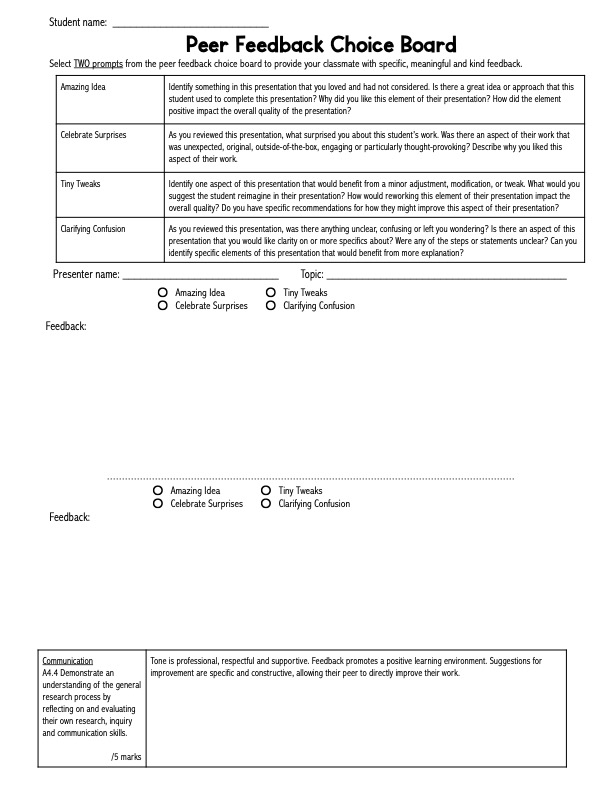
The carousel fair allowed the students to proudly discuss their conclusions and show off their research. Students who could confidently speak on their research did well and were able to defend their work and had to receive feedback from not only their teacher but their peers. This gave them a powerful way to connect their learning to a format that might be expected of them in postsecondary. While I was initially hesitant, taking a chance on the unknown brought unexpected, surprising results.
Resources: