One of the enduring challenges in teaching HHG4M (Human Growth and Development Throughout the Lifespan) is helping students move beyond seeing development as a checklist of isolated milestones. Nowhere is this more evident than in the study of infant development, where students often compartmentalize learning rather than understanding how deeply interconnected they are.
Hexagonal thinking offers a powerful, student-centred strategy to address this challenge. By asking students to physically and cognitively connect concepts, hexagonal thinking supports the HHG4M curriculum’s emphasis on systems, relationships, and holistic development—making the “big ideas” visible and meaningful.
Why Hexagonal Thinking?
Hexagonal thinking is a strategy where students use hexagon-shaped cards—each containing a concept, example, or factor—and arrange them so that shared edges represent meaningful connections. Unlike linear organizers, hexagons encourage multiple pathways, non-hierarchical thinking, and justification of relationships.
Most importantly, it pushes students to demonstrate a deeper understanding of key concepts and to answer the question: How does this connect?
Step 1: Identify Key Concepts
Begin by selecting 12–20 concepts related to infant development. These might include:
- Attachment
- Nutrition
- Brain development
- Sensory stimulation
- Motor skills
- Emotional regulation
- Language acquisition
- Caregiver responsiveness
- Sleep
- Play
- Attachment
- Failure to Thrive
Here is a Hexagon Template: 5. Hexagon 8 per page.pdf
Step 2: Build and Justify Connections
In small groups, students arrange the hexagons so that touching sides represent a meaningful relationship. For each connection, students must be able to explain why those concepts belong together.
This naturally leads students to see that no single PIES domain operates in isolation.
Making Thinking Visible
A key strength of hexagonal thinking is that it externalizes student reasoning. To deepen learning:
- Ask students to label connections with sentence strips (e.g., “supports,” “influences,” “depends on”)
- Have groups remove one hexagon and discuss how the system changes
- Invite students to compare layouts with other groups and explain differences
Step 3: Consolidation
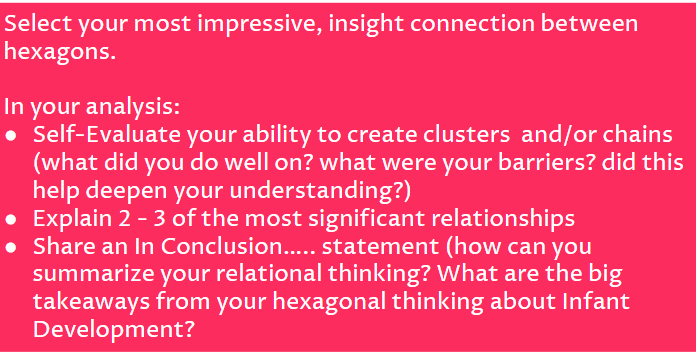
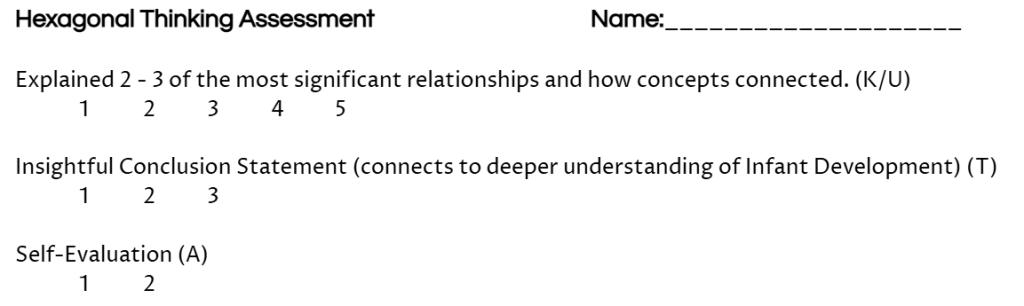
Have students verbally present their findings to you and consolidate their learning: